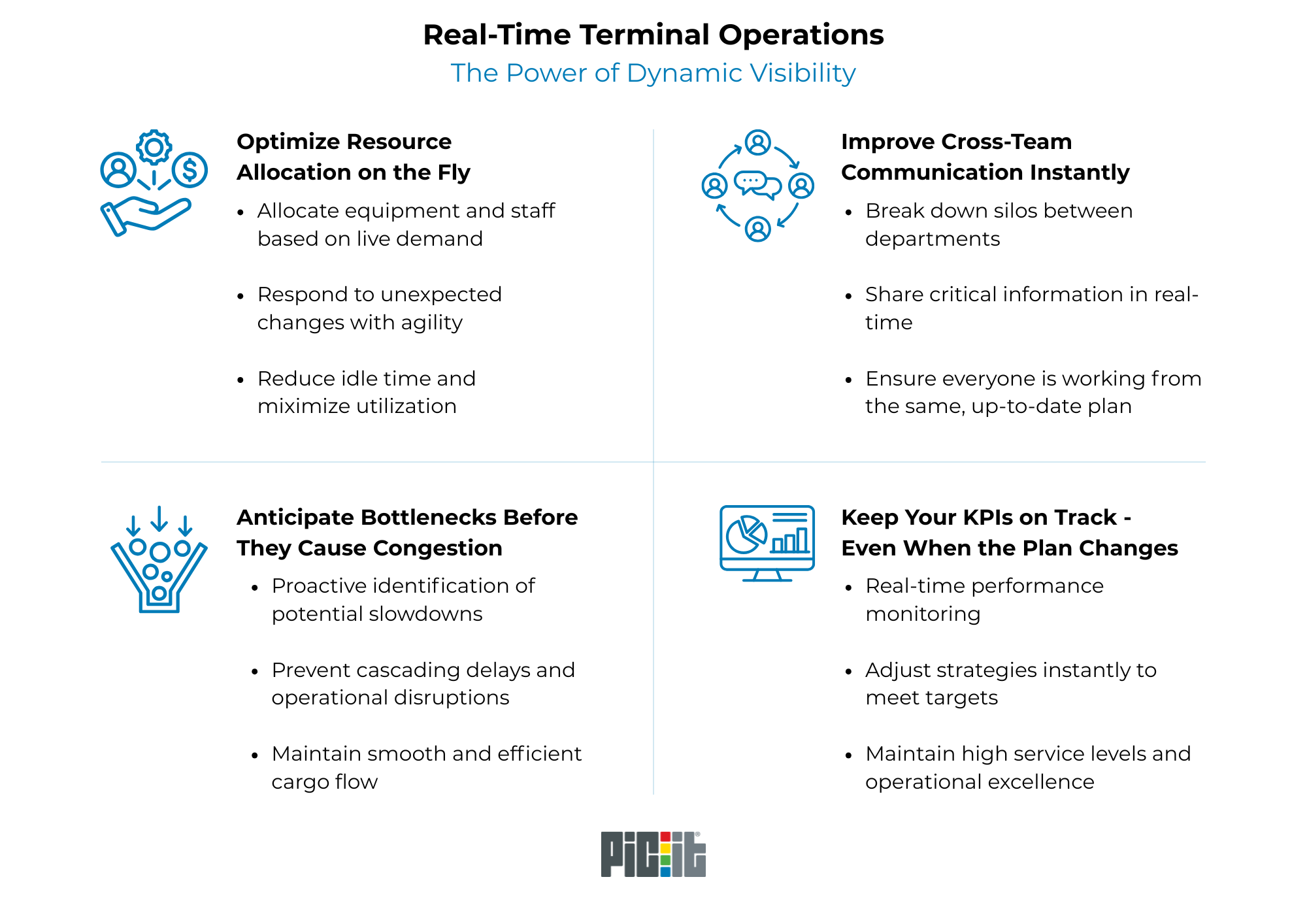
Operational control in terminal environments depends on confidence. Confidence in plans, confidence...
Introduction: Why Dispatch Matters
In transport operations, dispatch is where planning meets execution. It is the link between routes, drivers, vehicles, and customers. When dispatch runs smoothly, deliveries stay on time, resources are used efficiently, and communication is clear.
Yet in many operations, dispatch still relies on manual processes: spreadsheets, phone calls, and repeated updates across different tools. These methods can be effective at a small scale, but as operations grow, they become increasingly difficult to manage.
Automation offers a way forward. By streamlining workflows, dispatchers gain the clarity they need to manage complexity without adding unnecessary effort.
.png?width=600&height=350&name=Article%20(2).png)
The Limitations of Manual Dispatch
Time spent on repetitive coordination
In a manual setup, dispatchers often spend hours assigning tasks, checking availability, and updating drivers one by one. This leaves little time for strategic oversight.
Information spread across tools
Communication in one system, invoicing in another, when data is fragmented, no one has the full picture. Errors are more likely, and decision-making slows down.
Limited visibility during changes
Unexpected delays are inevitable. But when updates are handled manually, it takes time before information reaches everyone who needs it. That delay creates uncertainty across the operation.
The Cost of “Making Do”
Manual processes may seem manageable, but the hidden costs accumulate.
-
Lost efficiency: Dispatchers spend more time inputting data than managing operations.
-
Increased errors: Miscommunication and duplicated tasks grow as complexity increases.
-
Reduced scalability: Adding more vehicles makes manual processes exponentially harder.
-
Lower customer satisfaction: When changes aren’t communicated quickly, service levels decline.
In other words, “making do” with manual dispatch often means sacrificing performance and predictability.
What Automated Dispatch Delivers
By automating workflows, dispatchers reduce repetitive tasks and gain the visibility needed for effective decision-making. The impact can be seen in three key areas:
Streamlined assignments
Job allocation is automated based on pre-set criteria, such as driver availability, vehicle capacity, and delivery requirements. This saves time and reduces the risk of errors.
Real-time updates
As jobs are accepted, completed, or delayed, the system updates automatically. Dispatchers and drivers share the same information, keeping operations aligned.
Improved accuracy and visibility
With automation, dispatchers see the full picture at a glance. This allows them to spot bottlenecks, respond quickly to changes, and maintain reliable workflows.
From Reactive to Proactive
Consider how a delay is handled in two different setups:
-
Manual dispatch: A driver is stuck in traffic. The dispatcher only learns about it after repeated calls. Customers remain uninformed, and other drivers continue as planned. By the time adjustments are made, delays have already spread.
-
Automated dispatch: The system flags the delay instantly. The dispatcher sees the issue in real time, reassigns tasks where possible, and notifies customers automatically. The disruption is contained rather than amplified.
Automation does not remove disruptions. But it ensures they are handled quickly and consistently, protecting reliability.
Supporting Dispatchers, Not Replacing Them
Automation is often misunderstood as replacing human roles. In reality, it supports dispatchers by removing routine work, freeing them to focus on higher-value decisions.
Instead of repeating the same updates or chasing missing information, dispatchers can:
-
Anticipate issues before they escalate
-
Focus on optimizing resources
-
Strengthen communication with customers and partners
Automation becomes a partner in the dispatch process, not a substitute.
Building a Foundation for Growth
A modern Transport Management System (TMS) with automated dispatch is not just about solving today’s challenges. It creates a foundation for future growth:
-
Scalability: Add more vehicles or drivers without multiplying workload.
-
Consistency: Processes remain reliable even as complexity increases.
-
Agility: Operations can adapt quickly when disruptions occur.
-
Trust: Customers benefit from accurate, timely updates and dependable service.
With the right system in place, growth no longer means adding layers of manual work. It means building on a stable, efficient foundation.
Transitioning From Manual to Automated
Shifting from manual dispatch to automated workflows requires more than technology. It requires rethinking how processes are managed.
-
Assess current bottlenecks: Identify where manual processes cause delays or errors.
-
Define automation goals: Decide which tasks should be automated first (e.g., job assignment, notifications).
-
Ensure integration: Automated workflows are most effective when connected to the wider TMS, creating one source of truth.
-
Support teams during change: Dispatchers should be trained and involved, ensuring automation makes their work easier, not harder.
-
Measure impact: Track improvements in efficiency, response times, and customer satisfaction.
The transition is gradual, but each step toward automation reduces friction and increases clarity.
Conclusion: Clarity Through Automation
Dispatch plays a central role in transport operations. When processes are manual, inefficiencies build and scaling becomes difficult. When workflows are automated, dispatchers gain the clarity to manage complexity confidently.
Automation is not about removing people from the process. It is about supporting them with tools that streamline assignments, deliver real-time visibility, and enable faster, more accurate decision-making.
From manual to automated dispatch, the result is not just efficiency. It is the foundation for growth and reliable operations.
Book a Demo with our experts to let us help you take your dispatch from manual to automated.
Read more about PICit TOMS